L3 Differentiation
Question Bank
A curve is defined by the parametric equations
$ x = 4t - t^2, \quad y = 2t^3 + 5 $
Find $\dfrac{dy}{dx}$ in terms of $t.$
A curve is defined by $x = 3\cos 2t$ and $y = 2\sin t.$
Find the exact gradient of the curve at the point where $t = \dfrac{\pi}{6}.$
You must use calculus and show any derivatives that you need to find when solving this problem.
A curve is defined by the parametric equations
$ x = \sqrt{2t + 1}, \quad y = \ln(t^2 + 1) $
Find the gradient of the curve at the point where $t = 4.$
You must use calculus and show any derivatives that you need to find when solving this problem.
A curve is defined by $x = 2\sec t$ and $y = \tan 2t,$ for $0 < t < \dfrac{\pi}{4}.$
Find the exact gradient of the normal to the curve at the point where $t = \dfrac{\pi}{6}.$
You must use calculus and show any derivatives that you need to find when solving this problem.

A rugby ball is kicked from the ground. Its position $t$ seconds after the kick is
$ x = 18t, \quad y = 15t - 4.9t^2 $
where $x$ is the horizontal distance from the kicker and $y$ is the height above the ground, both in metres.
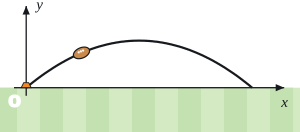
Find the gradient of the ball's path at the moment the ball lands.
You must use calculus and show any derivatives that you need to find when solving this problem.
A drone takes off from the ground. Its position $t$ seconds later is
$ x = 6t, \quad y = 30\left(1 - e^{-0.2t}\right) $
where $x$ is its horizontal distance from the take-off point and $y$ is its height, both in metres.
Find the drone's height at the moment its flight path has a gradient of $0.5.$
You must use calculus and show any derivatives that you need to find when solving this problem.
A curve is defined by $x = \ln t$ and $y = t^2 - 6t,$ for $t > 0.$
Find the exact coordinates of any point(s) on the curve where the gradient is $8.$
You must use calculus and show any derivatives that you need to find when solving this problem.
A curve is defined by $x = e^t - t$ and $y = e^{2t}.$
Find the equation of the tangent to the curve at the point where $t = \ln 2.$ Give your answer in the form $y = mx + c,$ where $c$ is exact.
You must use calculus and show any derivatives that you need to find when solving this problem.
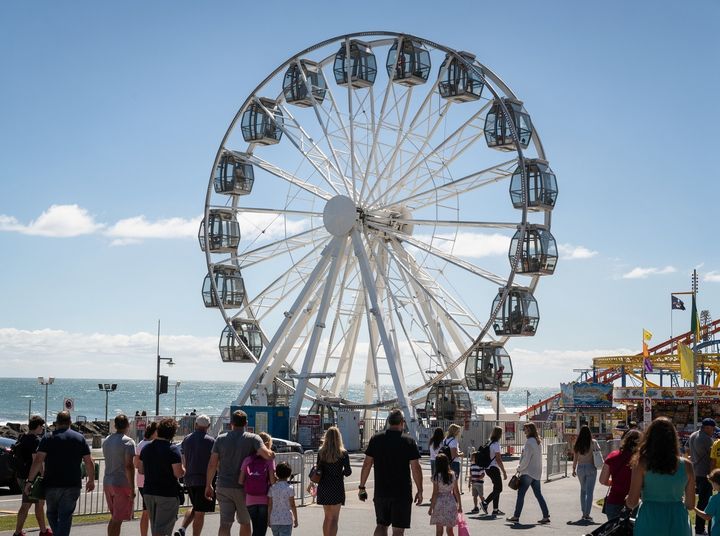
A Ferris wheel has a radius of 15 m and its centre is 17 m above the ground. It turns once every 30 seconds.
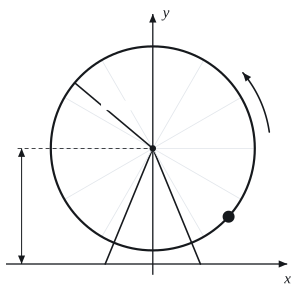
With the origin on the ground directly below the centre, the position of one gondola $t$ seconds after it passes the lowest point is
$ \begin{aligned}x &= 15\sin\left(\frac{\pi t}{15}\right)\\y &= 17 - 15\cos\left(\frac{\pi t}{15}\right)\end{aligned} $
where $x$ and $y$ are in metres.
During the first turn $(0 \le t \le 30),$ find the times when the gondola's path has a gradient of $\sqrt{3},$ and the gondola's height above the ground at each of those times.
You must use calculus and show any derivatives that you need to find when solving this problem.
A curve is defined by $x = t^2 + 1$ and $y = t^3 - 3t - 2.$
Find the equation of the normal to the curve at the point $(5, 0).$
You must use calculus and show any derivatives that you need to find when solving this problem.
A curve is defined by $x = t^2 - 4t$ and $y = t^3 - 3t.$
Find the coordinates of all the points on the curve where the tangent is horizontal, and of all the points where the tangent is vertical.
You must use calculus and show any derivatives that you need to find when solving this problem.
A curve is defined by $x = t^2 + 2t$ and $y = t^3 + 3t.$
Find the value of $\dfrac{d^2y}{dx^2}$ at the point where $t = 1,$ and state whether the curve is concave up or concave down at that point.
You must use calculus and show any derivatives that you need to find when solving this problem.
A curve is defined by $x = 4 - t^2$ and $y = t^3 - 2t.$
The curve crosses the $y$-axis at two points. Find the equations of the tangents to the curve at these two points, and the coordinates of the point where the two tangents meet.
You must use calculus and show any derivatives that you need to find when solving this problem.
A curve is defined by $x = t^2$ and $y = t^3 + kt,$ for $t > 0,$ where $k$ is a constant.
At the point where $t = 1,$ $\dfrac{d^2y}{dx^2} = -\dfrac{9}{4}.$
Find the value of $k,$ and hence find the coordinates of the point of inflection on the curve.
You can assume that your point found is actually a point of inflection.
You must use calculus and show any derivatives that you need to find when solving this problem.
A small stone is stuck in the tread of a bicycle tyre of radius $r$ metres. As the bicycle rolls along flat ground, the stone follows the path
$ \begin{aligned}x &= r(t - \sin t)\\y &= r(1 - \cos t)\end{aligned} $
where $t$ is the angle (in radians) that the wheel has turned since the stone last touched the ground.
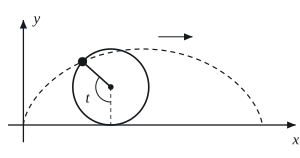
Find $\dfrac{d^2y}{dx^2}$ in terms of $r$ and $t,$ and hence prove that the stone's path is concave down for $0 < t < 2\pi.$
You must use calculus and show any derivatives that you need to find when solving this problem.