L3 Differentiation
Question Bank
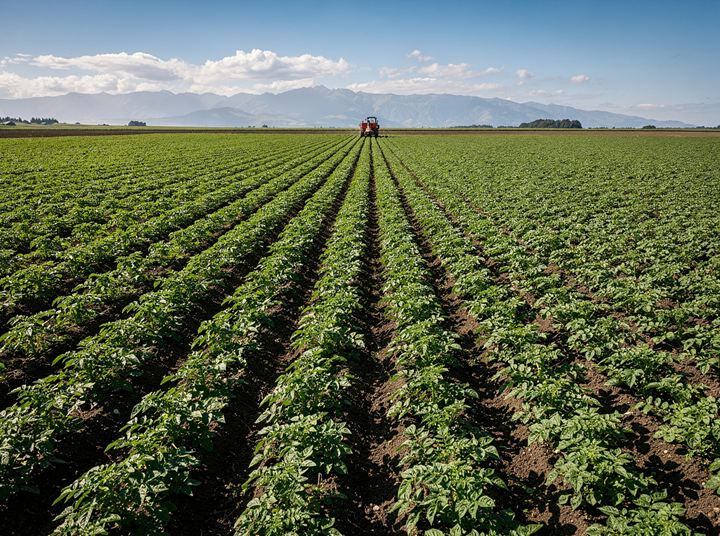
The yield, $Y$ tonnes per hectare, of a potato crop when $N$ kg of nitrogen fertiliser per hectare is spread on it is modelled by
$ \begin{aligned}Y &= 30 + 12\ln(1 + 0.02N)\\[0pt]&\quad {} - 0.04N\end{aligned} $
where $N \ge 0$.
Find the amount of fertiliser that gives the greatest yield, and the greatest yield correct to 3 significant figures.
You must use calculus and show any derivatives that you need to find when solving this problem.
You may assume that your answer is a maximum.
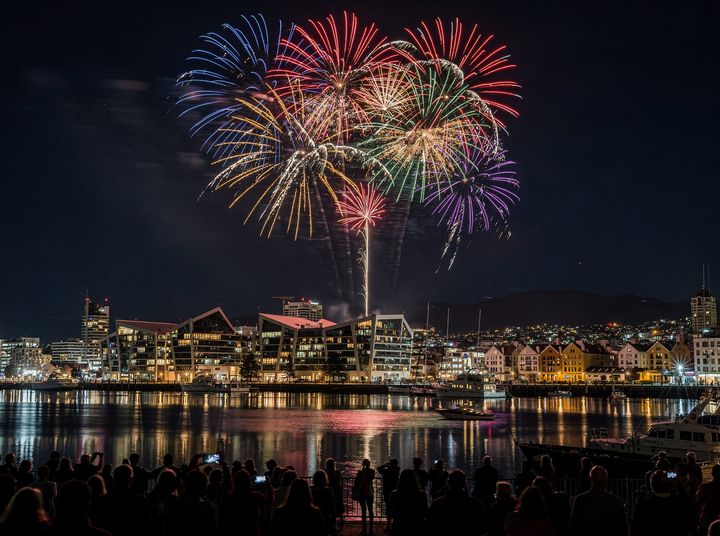
A firework shell is fired straight up into the air. Its height, $h$ metres, $t$ seconds after it is fired is modelled by
$ h = 490\left(1 - e^{-0.2t}\right) - 49t $
Find the greatest height that the shell reaches, correct to 3 significant figures.
You must use calculus and show any derivatives that you need to find when solving this problem.
You may assume that your answer is a maximum.

After a tablet is swallowed, the concentration of a medicine in a patient's blood, $C$ mg/L, $t$ hours later is modelled by
$ C = 20\left(e^{-0.2t} - e^{-0.8t}\right) $
Find the greatest concentration and the time at which it occurs, each correct to 3 significant figures.
You must use calculus and show any derivatives that you need to find when solving this problem.
You may assume that your answer is a maximum.
The diagram shows part of the curve $y = 3 - \ln x$, for $0 < x < e^3$.
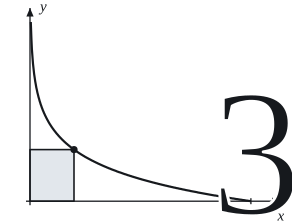
The rectangle $OABC$ has $O$ at the origin, $A$ on the $x$-axis, $C$ on the $y$-axis and $B$ on the curve.
Find the greatest possible area of the rectangle. Give your answer in exact form.
You must use calculus and show any derivatives that you need to find when solving this problem.
You may assume that your answer is a maximum.
$P$ is a point on the curve $y = x^2$ and $A$ is the point $(3, 0)$.
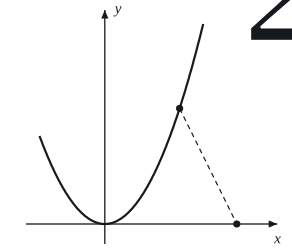
Find the coordinates of the point $P$ that is closest to $A$, and the shortest distance from $A$ to the curve.
You must use calculus and show any derivatives that you need to find when solving this problem.
You may assume that your answer is a minimum.
A farmer is fencing a rectangular paddock with an area of $2400\text{ m}^2$ against a straight hedge, so only three sides need a fence.
The side parallel to the hedge runs along the road, and its fence costs $\unicode{36}25$ per metre. The fence on each of the other two sides costs $\unicode{36}12$ per metre.
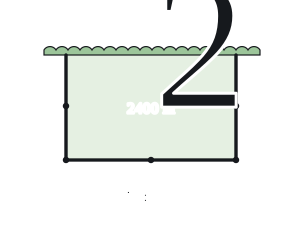
Find the dimensions of the paddock that make the fence as cheap as possible, and the least cost.
You must use calculus and show any derivatives that you need to find when solving this problem.
You may assume that your answer is a minimum.
An open box (it has no lid) is made from thin card. Its base is a rectangle whose length is twice its width, and the box must hold $36\,000\text{ cm}^3$.
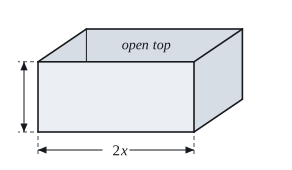
Find the dimensions of the box that use the least card, and the area of card used.
You must use calculus and show any derivatives that you need to find when solving this problem.
You may assume that your answer is a minimum.
A company makes closed cylindrical cans that each hold $1000\text{ cm}^3$.
The curved side of a can is cut from a rectangle of metal with no waste. Each end is stamped out of a square of metal whose sides are equal to the diameter of the can, and the corners of the square are wasted.
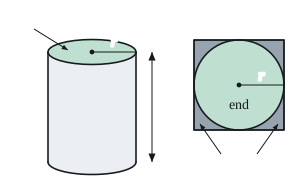
Find the radius and the height of the can that uses the least metal, including the waste. Give the height correct to 3 significant figures.
You must use calculus and show any derivatives that you need to find when solving this problem.
You may assume that your answer is a minimum.
The diagram shows the curve
$ y = \frac{k}{x^2 + k^2} $
where $k$ is a positive constant.
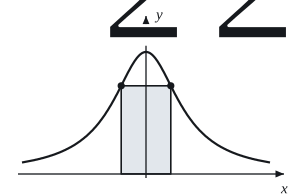
The rectangle $ABCD$ has $A$ and $B$ on the $x$-axis and $C$ and $D$ on the curve, and it is symmetrical about the $y$-axis.
Prove that the greatest possible area of the rectangle is 1 square unit, whatever the value of $k$.
You must use calculus and show any derivatives that you need to find when solving this problem.
A tent in the shape of a cone is held up by straight poles 3 m long. Each pole runs from the ground to the top of the tent along its sloping side, so the slant height of the cone is 3 m.
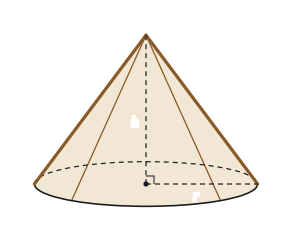
Find the height of the tent that gives the greatest volume, and this greatest volume. Give your answers in exact form.
Show that the height you have found gives the greatest volume.
You must use calculus and show any derivatives that you need to find when solving this problem.
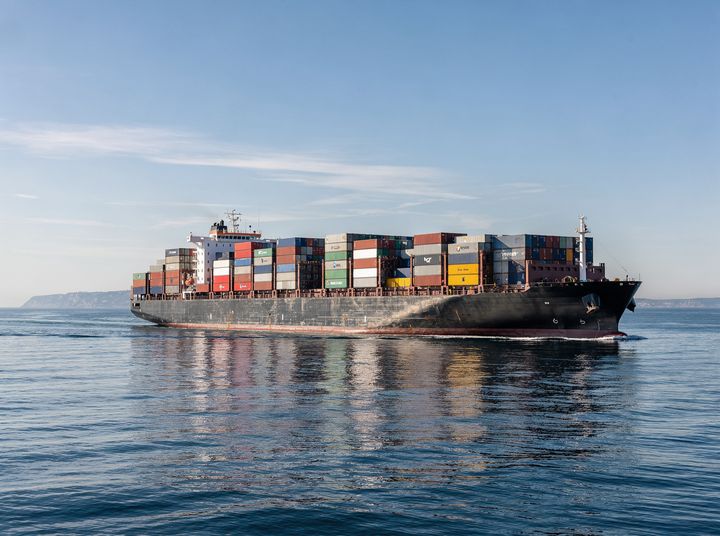
A cargo ship makes a voyage of $D$ km at a steady speed of $v$ km/h. Its fuel costs $kv^3$ dollars per hour, and its other running costs (crew, insurance and so on) are $F$ dollars per hour, where $k$ and $F$ are positive constants.
(a) Prove that the cheapest speed for the voyage is the speed at which the fuel cost per hour is half of the other running costs per hour, whatever the length of the voyage.
(b) At 20 km/h the ship's fuel costs $\unicode{36}800$ per hour, and its other running costs are $\unicode{36}5400$ per hour. Find the cheapest speed, and the total cost of a 1500 km voyage at that speed.
You must use calculus and show any derivatives that you need to find when solving this problem.
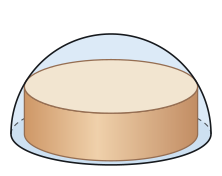
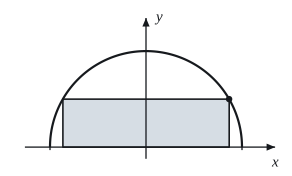
A cylinder stands inside a hemisphere of radius $R$. The base of the cylinder is on the flat face of the hemisphere, the two shapes have the same axis of symmetry, and the rim of the top of the cylinder touches the curved surface.
The diagrams show the cylinder inside the hemisphere, and a cross-section through the axis drawn on $x$ and $y$ axes. O is the centre of the flat face, and $P(x, y)$ is a top corner of the cylinder's cross-section, so the cylinder has radius $x$ and height $y$.
Prove that the greatest possible area of the curved surface of the cylinder is equal to the area of the flat face of the hemisphere.
You must use calculus and show any derivatives that you need to find when solving this problem.
The curve $y = a^2 - x^2$, where $a$ is a positive constant, crosses the $x$-axis at $A(-a, 0)$ and $B(a, 0)$.
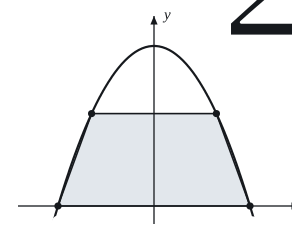
The points $P$ and $Q$ lie on the curve above the $x$-axis, with $PQ$ parallel to $AB$, so that $ABQP$ is a trapezium.
Prove that the greatest possible area of the trapezium is $\dfrac{32a^3}{27}$.
You must use calculus and show any derivatives that you need to find when solving this problem.
A cone has height $H$ and base radius $R$. A smaller cone is placed upside down inside it: its vertex is at the centre of the large cone's base, the two cones have the same axis, and the rim of the small cone's base touches the curved surface of the large cone.
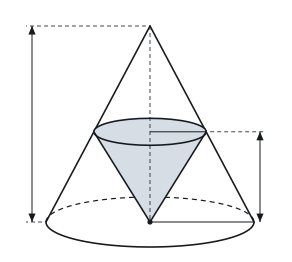
Prove that the greatest possible volume of the small cone is $\dfrac{4}{27}$ of the volume of the large cone.
You must use calculus and show any derivatives that you need to find when solving this problem.
An offshore gas platform $P$ is 8 km from $N$, the nearest point on a straight coastline. A processing station $S$ is on the coast, 15 km from $N$.
A pipeline will run under the sea in a straight line from $P$ to a point $X$ on the coast between $N$ and $S$, then along the coast from $X$ to $S$. Pipe laid on land costs $c$ dollars per km, and pipe laid under the sea costs $k$ times as much, where $k \ge 1.2$.
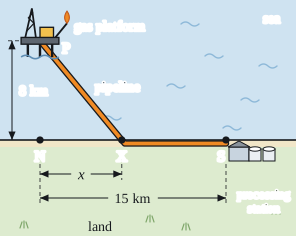
Prove that the cheapest pipeline comes ashore $\dfrac{8}{\sqrt{k^2 - 1}}$ km from $N$.
You must use calculus and show any derivatives that you need to find when solving this problem.
During a match at the 2026 FIFA World Cup, a winger runs with the ball towards the goal-line, along a straight line that is parallel to the touchline and 9 m outside the near goalpost. The goal is 7.32 m wide.
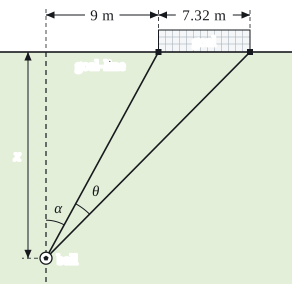
When the ball is $x
nbsp;metres from the goal-line, $\theta$ is the angle between the lines from the ball to the two goalposts.Find the value of $x$ that makes the angle $\theta$ as large as possible, and this largest angle in degrees. Give your answers correct to 3 significant figures.
You do not need to prove that the angle you have found is a maximum.
You must use calculus and show any derivatives that you need to find when solving this problem.
A lifeguard is at $L$, at the water's edge on a straight beach. A swimmer in trouble is at $S$, 60 m out from the shore. $N$ is the point on the shore closest to the swimmer, and it is 150 m along the beach from $L$.
The lifeguard runs along the water's edge at 4 m/s to a point $E$ between $L$ and $N$, then paddles a rescue board in a straight line from $E$ to $S$ at 2.4 m/s.
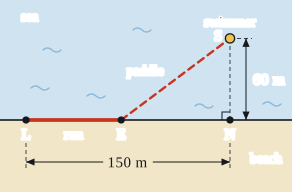
Find how far from $L$ the lifeguard should go into the water to reach the swimmer in the least possible time, and find this time. Prove that your answer gives the minimum time.
You must use calculus and show any derivatives that you need to find when solving this problem.
An open channel to carry water on a farm is made from a long, flat sheet of steel 30 cm wide. The sheet is bent along two lines, each 10 cm from an edge, so that the middle 10 cm forms a flat, horizontal base and each side makes the same angle $\theta$ with the horizontal, where $0 < \theta \le \dfrac{\pi}{2}$. The diagram shows a cross-section of the channel.
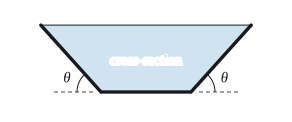
Find the angle $\theta$ that gives the largest cross-sectional area, and this largest area in exact form.
You do not need to prove that the area you have found is a maximum.
You must use calculus and show any derivatives that you need to find when solving this problem.
A ball of radius $r$ sits inside a hollow cone, touching the cone's base and touching its curved surface all the way round. The cone has height $H$ and base radius $R$. The diagrams show the cone and ball, and a cross-section through the cone's axis.
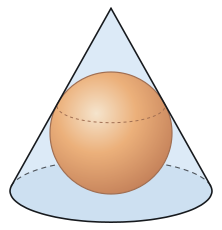
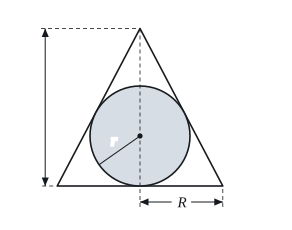
It can be shown that
$ R^2 = \frac{r^2H}{H - 2r} $
Prove that the cone with the least volume has height $4r$, and that its volume is twice the volume of the ball.
You must use calculus and show any derivatives that you need to find when solving this problem.
A fence 1.35 m high stands on level ground, 3.2 m from the wall of a house and parallel to it.
A ladder is placed with its foot on the ground on the far side of the fence from the house. It rests on the top of the fence, and its top touches the wall. The ladder makes an angle $\theta$ with the ground. Treat the ladder as a line segment.
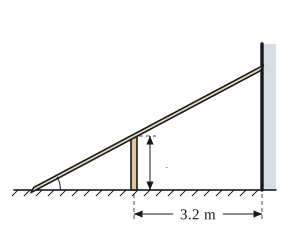
Find the length of the shortest ladder that can reach the wall in this way, and decide whether a 6 m ladder is long enough.
You must use calculus and show any derivatives that you need to find when solving this problem.